Commodity Channel Index (CCI)
Introduction:
The Commodity Channel Index, CCI, is designed to detect beginning and ending
market trends. The formula standardizes market prices so that the trader can
spot deviations from the market’s trend more easily.
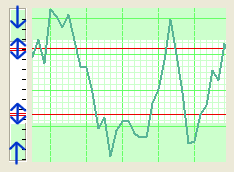
Proponents of this indicator say that 70% to 80% of all price fluctuations fall
within +100 and -100 as measured by the index. This is akin to technical lore
that most of the time, markets trade in a sideways trend or channels. However,
when the indicator moves out of this range, it is said that a trend is underway.
You will notice that the above calculation is very similar to that of a
histogram Moving Average Convergence Divergence (MACD), as the CCI measures the
average daily prices distance from an moving average of average daily prices, in
much the same way that MACD measures the distance between moving averages from a
base line.
The trading rules for the CCI are as follows. Establish a long position when the
CCI exceeds +100. Liquidate when the index drops below +100. For a short
position, you use the -100 value as your reference point. Any value less than
-100, e.g. -125, suggests a short position, while a rise to -85 tells you to
liquidate your short position.
Interpretation:
Generally, followers of the CCI look to establish long positions when the CCI
exceeds the +100 level, indicating that prices are in a strong up trend.
Generally, most users of this indicator also try to look for patterns with in
the indicator, such as higher highs and look for CCI movements to be confirmed
by general price readings as well.
Standard interpretation calls for long positions, once initiated on the upward
exceeding of the +100 level, to be held until the CCI falls back below +85, at
which time positions are exited as the market has stopped trending upward.
Short positions are generally established when the CCI index goes lower than
–100, indicating that prices are in a strong down trend. Like long positions,
most users of this indicator try to watch out for patterns within the CCI itself
to confirm the downward trend, and also look for confirmation from lower prices
on the chart itself.
Once a short position is established, the original interpretation of this
indicator calls for holding the position until the index exceeds –85 to the
upside, at which time short positions should be covered.
The purpose of the CCI index is to try to keep you out of the market during
consolidation or weakly trending periods. By measuring the difference average
prices versus mean average prices, this indicator attempts to isolate only
strongly trending markets, similar to momentum and MACD.